Blogs
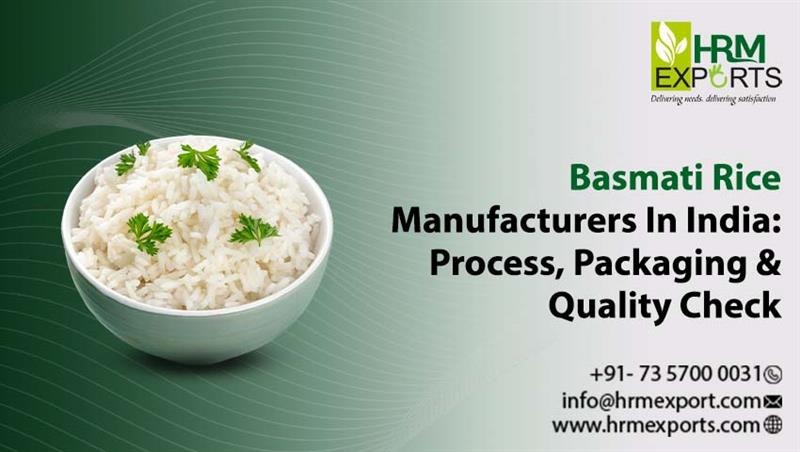
Basmati Rice Manufacturers In India: Process, Packaging & Quality Check
India is the world leader in aromatic grains with more than 70 percent of Basmati production across the globe. Whether they are culinary lovers or international traders, it is important that they know how Basmati rice manufacturers in India are able to reach such high level of standard. It is a complex combination of ancient knowledge and the latest technology that the experience of a muddy paddy field in the Himalayan foothills to a top-quality vacuum-packed pack takes place.
In this blog, we will discuss the end to end manufacturing lifecycle, strict quality standards established by Indian officials, and the special packaging methods that maintain the Scented Pearl to the international kitchens.
Indian Core Process of Basmati Rice Manufacturers
Basmati is much more complicated to produce than long-grain rice. It is a gradual, careful process which is focused on the preservation of the delicate structure of the grain and the natural fragrance.
1. Harvesting and Threshing
The production starts in the fertile plains of North India. When the crop has attained the ultimate maturity, that is, three months, it is harvested. The time is very important, because when harvested too early the grains would be weak, whereas when they are harvested late, the grains would crack. After harvesting, threshing is done to separate the grain, straw and husk.
2. The Art of Ageing
Basmati, unlike other types of rice is like fine wine, it gains with time. The major manufacturers of Basmati rice in India mature their paddy between 12 to 24 months in controlled warehouses in terms of temperature. This involves loss of moisture content and changes the starch structure so that the grains do not stick together and the grains reach their highest elongation on cooking.
3. Multi-Stage Milling
The paddy is taken into the mill after ageing. The milling procedure is carried out in a number of different stages to reduce breakage:
• Cleaning: Elimination of stones, dust and the foreign elements.
• Dehusking: Removal process of the outer brown husk to make the brown rice.
• Whitening and the Polishing: Eliminating the layer of the bran. A special type of mist polishers are frequently applied to provide the grains with a characteristic, translucent and silky finish.
• Grading: Separating the rice based on length through the use of plan-sifters and indent cylinders.
4. Color Sorting
In India, new Basmati rice producers use CCD (Charge-Coupled Device) color sorters of high technology. These robot eyes scan each and every grain, and with compressed air, shoot out any discolored, yellow, or chalky grains in the lightning speed.
Packaging: Retaining the Heritage
The last process to the Basmati rice manufacturers in India is to ensure that the product reaches to the consumer without losing its soul- its aroma.
Techniques of Advanced Packaging:
• Choice of Material: Jute is used by manufacturers (to allow breathability), Non-Woven bags or Biaxially Oriented Polypropylene (BMPP) when they need a high-end, waterproof finish depending on the destination.
• Nitrogen Flushing: In the retail packs, nitrogen usually takes the position of oxygen in order to avoid oxidation and preserve the rice over many years.
• Vacuum Packaging: This is commonly applied in "Pesticide Free" or Organic varieties in order to avoid any form of insect infestation without the use of chemicals.
• Branding & Traceability: Packs are printed with the batch numbers and the QR codes, which enable consumers to trace rice to the particular group of farms.
Final Thoughts
Basmati Rice Manufacturers in India have a reputation that relies on uniformity and attention. At the forefront of this heritage, HRM Exports is a blend of natural ageing in the ancient past and the latest laser sorting and vacuum packaging to establish standards globally. They are an ISO 9001: 2008 certified leader with superior QC labs to promote varietal purity. HRM Exports has made sustainable farming and transparent supply chains their main focus to make their high-quality grains, including 1121 to traditional aromatic, turn every meal into a culinary experience of customers all over the world.
FAQs
The Himalayan climate of India offers Basmati with the special soil and climate.
The process of ageing decreases the moisture, increases the aroma, and avoids sticking of grains.
Exported bags are made of Jute, Non-Woven bags, and moisture-proof BOPP.
It helps to avoid insect invasion and natural aroma is preserved without chemicals.
23 Sep, 2026
Indian Basmati Rice Supplie ...
Latest Posts